


The art and science behind textiles that sculpt themselves
2025-12-03

As a doctoral student at the Swedish School of Textiles, Kathryn Walters initially developed methods for working with combinations of shrinking and resisting yarns.
“As the research evolved, I wanted to move away from synthetic yarns and explored the use of high-twist linen yarn which transforms reversibly and repeatedly in response to moisture. These yarns do not require any chemical treatment and remain fully biodegradable, but are capable of generating new movements and forms in the textiles,” said Kathryn Walters, who defended her doctoral thesis Designing woven textiles with transformative behaviour on 21 November.
“Through my research, I aim to provide inspiration and tools to develop new forms of woven textiles with transformative behaviour, to explore active materials and how they can be integrated into textiles that move, morph, and behave”.
Two types of transformative textiles
The research findings are presented as models for designing with these two types of transformative textiles: shrinking/resisting and twisting. While textiles are commonly perceived to be static and inert, textiles with transformative behaviour often possess emergent behaviour, behaving in unexpected ways and subject to sudden changes in behaviour from small changes. That is the part Kathryn Walters found most fascinating about her research: unpacking why a textile has behaved in a certain way or produced a specific form.
“More generally, I was surprised by the effectiveness of the high-twist linen yarn and the non-linearity of its behaviour. It was very sensitive to the scale of the textile, changing behaviour dramatically when scaled up, and this emphasised the need to test and prototype at full scale,” said Kathryn Walters, who currently holds a position as Assistant Professor in the School of Architecture & Design at IE University in Spain.
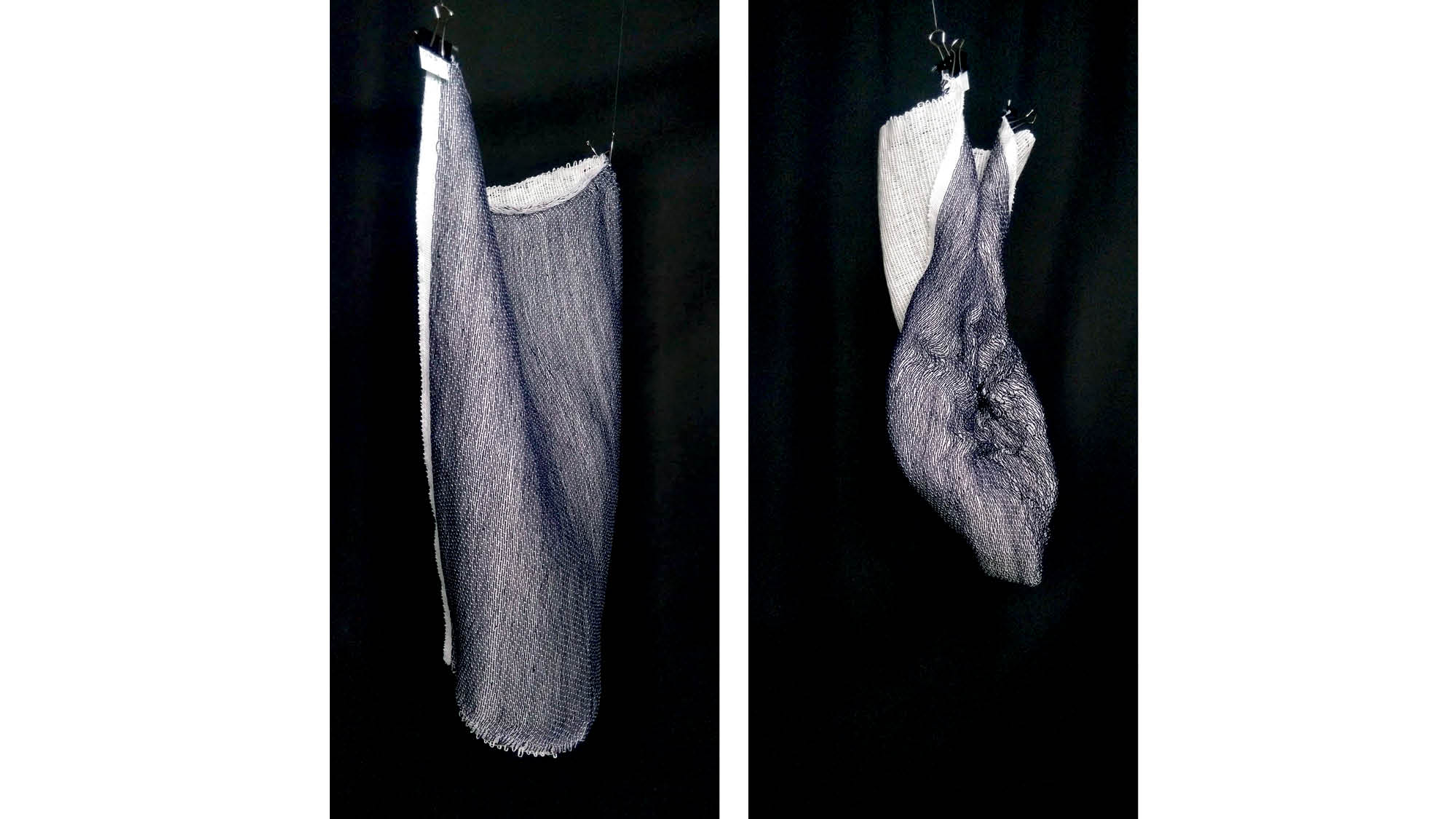
Samples of high-twist linen yarn before activation (left) and at maximal activation (right). Photo: Kathryn Walters
This foundational research is aimed mostly at other textile designer weavers or researchers interested in exploring textiles with transformative behaviour beyond e-textiles. The results of the research are mostly in the form of models for designing with shrinking/resisting or high-twist yarns. These are accompanied by a diagramming technique for designing or analysing transformative textiles and a set of experimental textile design methods for exploring non-linear behaviour.
The thesis was defended 21 November
External Reviewer: Dr Sara Robertson, Sara + Sarah Smart Textile Design, UK
Examining Committee:
Professor Tim Parry-Williams, University of Bergen, Norway
Professor Jessica Hemmings, University of Gothenburg
Docent Junchun Yu, University of Borås
Supervisor: Senior Lecturer Karin Landahl, University of Borås
Read more
Read the thesis Designing woven textiles with transformative behaviour
Lina Färm
Textile samples: Kathryn Walters / Portrait: Johfors Productions